
UK Government announces major funding boost for quantum technologies
Today, the UK Government announced a major new funding injection worth up to £2 billion to establish the UK as a world leader in quantum technologies.
This includes an additional investment of £13.8 million dedicated to the National Quantum Technologies Programme Hubs, which includes Q-BIOMED.
“This major new investment in the UK’s quantum ecosystem represents a leap in ambition to unlock the potential economic and societal impacts of quantum technology,” said Professor John Morton, Q-BIOMED Principal Investigator and Co-Director.
“At Q-BIOMED, this funding will accelerate our work on translating breakthrough quantum science into technologies that can transform healthcare through earlier diagnosis, enabling better treatment decisions and improved patient outcomes.
“We’re proud to be part of a visionary national effort that is shaping the future of quantum innovation.”
The announcement was accompanied by a visit to the National Quantum Computing Centre (NQCC), where our Co‑Director Professor Dame Molly Stevens met with Liz Kendall, Secretary of State for Science, Innovation and Technology, and Rachel Reeves, Chancellor of the Exchequer.
The visit provided an opportunity to showcase how Q‑BIOMED’s research in quantum biomedical sensing aligns with the UK’s wider ambitions for quantum technologies — demonstrating how breakthroughs in sensing, materials and measurement science are already beginning to translate into real‑world healthcare impact.
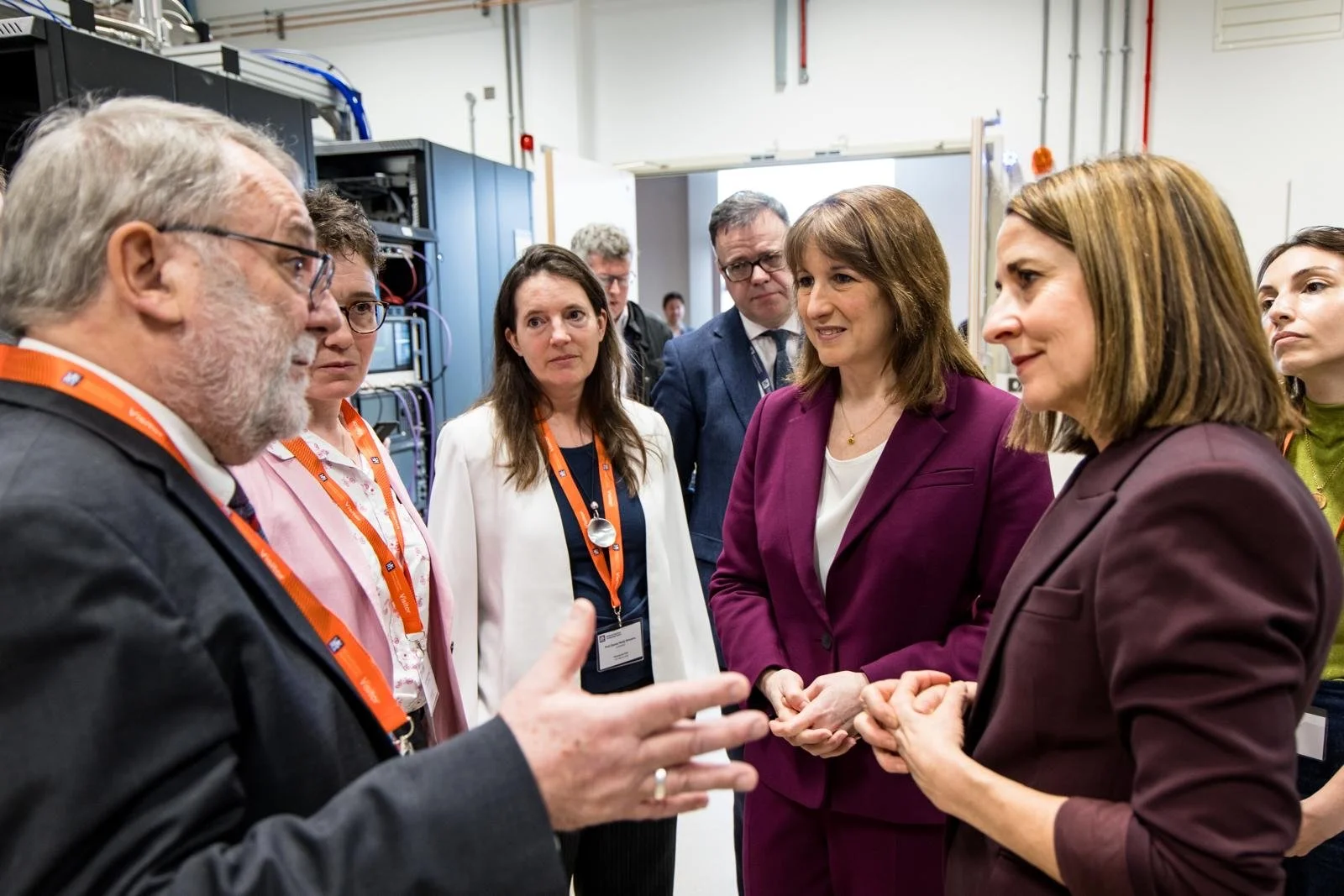
Q-BIOMED Co-Director Professor Dame Molly Stevens was invited to the NQCC to discuss the promise of quantum technologies
Wearable brain scanners for epilepsy
The announcement highlighted several quantum technologies already in use across the UK, including work by researchers at the UCL Department of Imaging Neuroscience and the Research Department of Epilepsy, Institute of Neurology (supported by the Wellcome Trust and the Epilepsy Research Institute) who have been collaborating with Q-BIOMED to use optically pumped magnetometers (OPMs) to measure brain activity in people with epilepsy.
OPMs detect tiny magnetic fields using light and the quantum properties of atoms. Their exceptional sensitivity allows researchers to non‑invasively record magnetic signals produced by the brain- a technique known as magnetoencephalography (MEG).
Because OPMs are compact and can be positioned close to the scalp, they offer improved signal quality compared with traditional systems. When integrated into a wearable helmet, they can record brain activity while a person moves naturally. Unlike conventional SQUID‑based MEG scanners, which require extremely low temperatures, OP‑MEG operates at room temperature, making it more practical and potentially more accessible.
Supported by the Epilepsy Research Institute, Dr Umesh Vivekananda (Q‑BIOMED Deputy Director and Deputy Chair of our Clinical Steering Group) pioneered the use of OP‑MEG in patients with epilepsy to improve diagnosis and treatment. In the future, OP‑MEG could play an important role in surgical planning, helping surgeons pinpoint the precise brain regions involved in seizures.
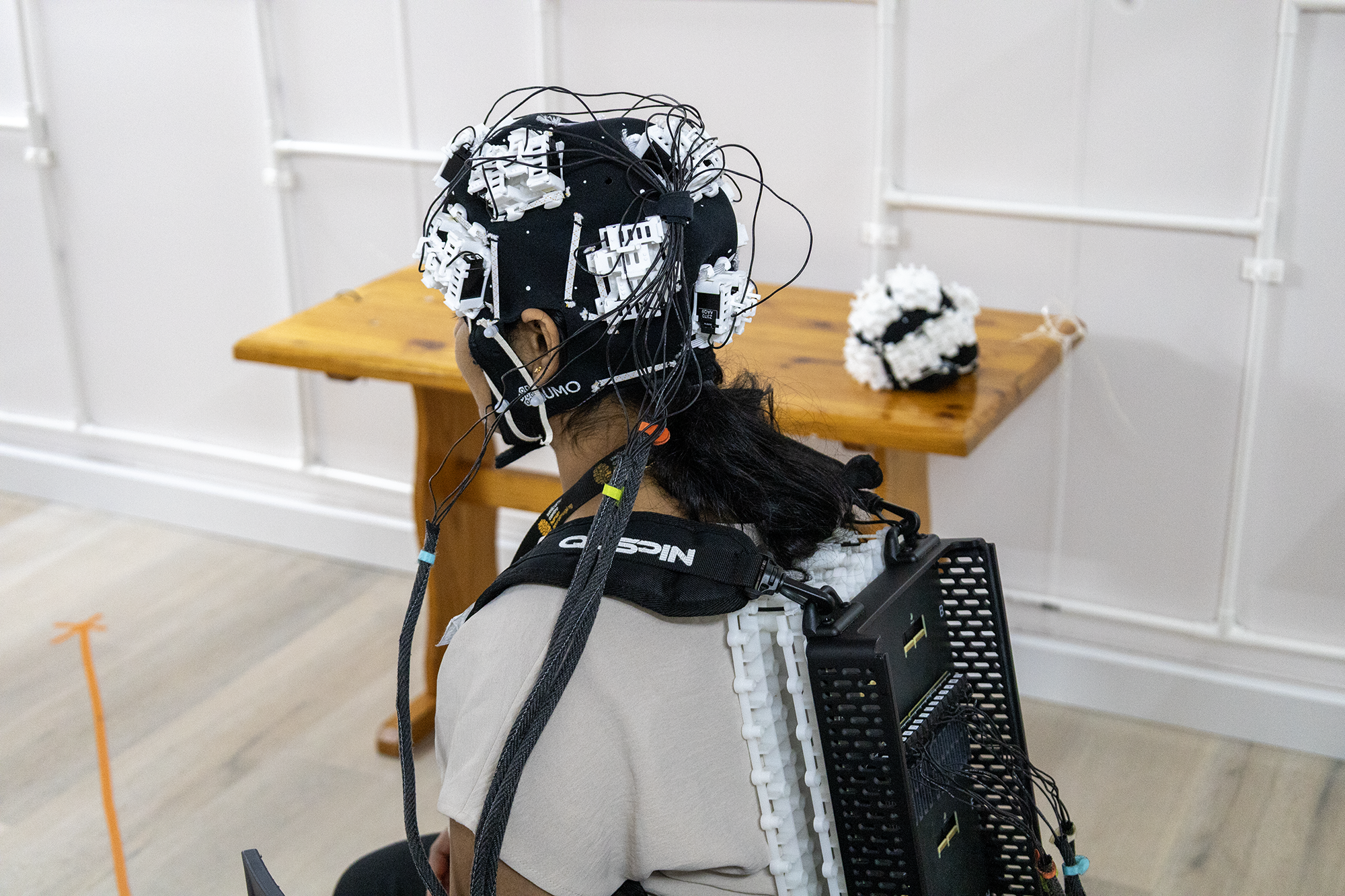
Researchers at the Wellcome funded Department for Imaging Neuroscience at University College London are using OPM-MEG to measure brain activity in people with epilepsy.
“We’re entering an exciting phase for OPM‑MEG and other quantum sensing technologies,” said Umesh Vivekananda.
“This funding will help Q-BIOMED push the technology further and explore how it can transform diagnosis and treatment for people with epilepsy and other conditions, such as Alzheimer’s. Being able to capture detailed brain activity while patients move freely opens entirely new possibilities.”
Accelerating UK quantum progress
The new funding announced today will help cement the UK’s position as a global leader in emerging technologies, creating new opportunities for British businesses and opening new routes for investment.
Next week, a first-of-its-kind procurement programme called ‘ProQure:Scaling UK Quantum Computing’ will launch. This initiative will bring together R&D, manufacturing, software, hardware and procurement within a single framework, positioning the UK to become a world leader in developing and deploying large‑scale quantum computers.
“Today’s announcements are an investment in our future – unlocking better health, wealth, and more opportunities for communities across the country,” said Liz Kendall, Secretary of State for Science, Innovation and Technology.
"This government is ushering in a Quantum leap - making the choice today to back UK scientists, companies, and innovators so we can deliver a future that works for all.”
The new funding will also strengthen the UK’s quantum infrastructure and support the development of specialist talent. This includes an additional £90 million to expand national infrastructure and meet the growing scaling needs of industry. A further £20 million has been committed to new skills and commercialisation programmes. To help build a strong pipeline of quantum experts, government’s flagship TechFirst Programme will launch new partnerships with companies in the sector, offering up to 100 fully funded internships.
Together, these investments mark a significant step in ensuring the UK remains at the forefront of quantum innovation. For Q-BIOMED and its partners, the announcement will accelerate the translation of cutting‑edge research into real‑world impact - from wearable brain scanners to next‑generation healthcare technologies - helping to unlock the full potential of quantum sensing for society.