
Workshop highlights: AI and ML for quantum sensing
From 23-25 March 2026, Q-BIOMED hosted a workshop on artificial intelligence and machine learning techniques for quantum sensing, bringing together early career researchers from across the Hub.
In the article below, UCL PhD student Ali Shokat gives his summary and reflections on the three-day event.
We would like to extend our thanks to Professor Mehrnoosh Sadrzadeh from the UCL Department of Computer Science and Quantum Learning Labs, as well as all of our invited speakers, for contributing to the workshop.
The AI/ML workshop started with an introductory Bayesian methods lecture given by Professor Brooks Paige. This lecture started with fundamental statistics, and then went into the computational methods involved, such as Markov Chain Monte Carlo methods. Starting with the basics and going into working examples in the tutorial was particularly helpful for cementing the knowledge given in the lectures before.
Following a fun introduction to shuffleboard for our dinner and social, the next day commenced with a lecture on Deep Learning from Dr Dariush Hosseini. This lecture introduced us to different Neural Network Architectures, which was then followed by a tutorial given by Kin Ian Lo. The tutorial involved building a very simple neural network in Python, which was extremely insightful as to how architectures such as a Multi-Layer Perceptron can learn functions, alongside the role of forward passing and back-propagation in optimising a network and minimising the loss function during training.
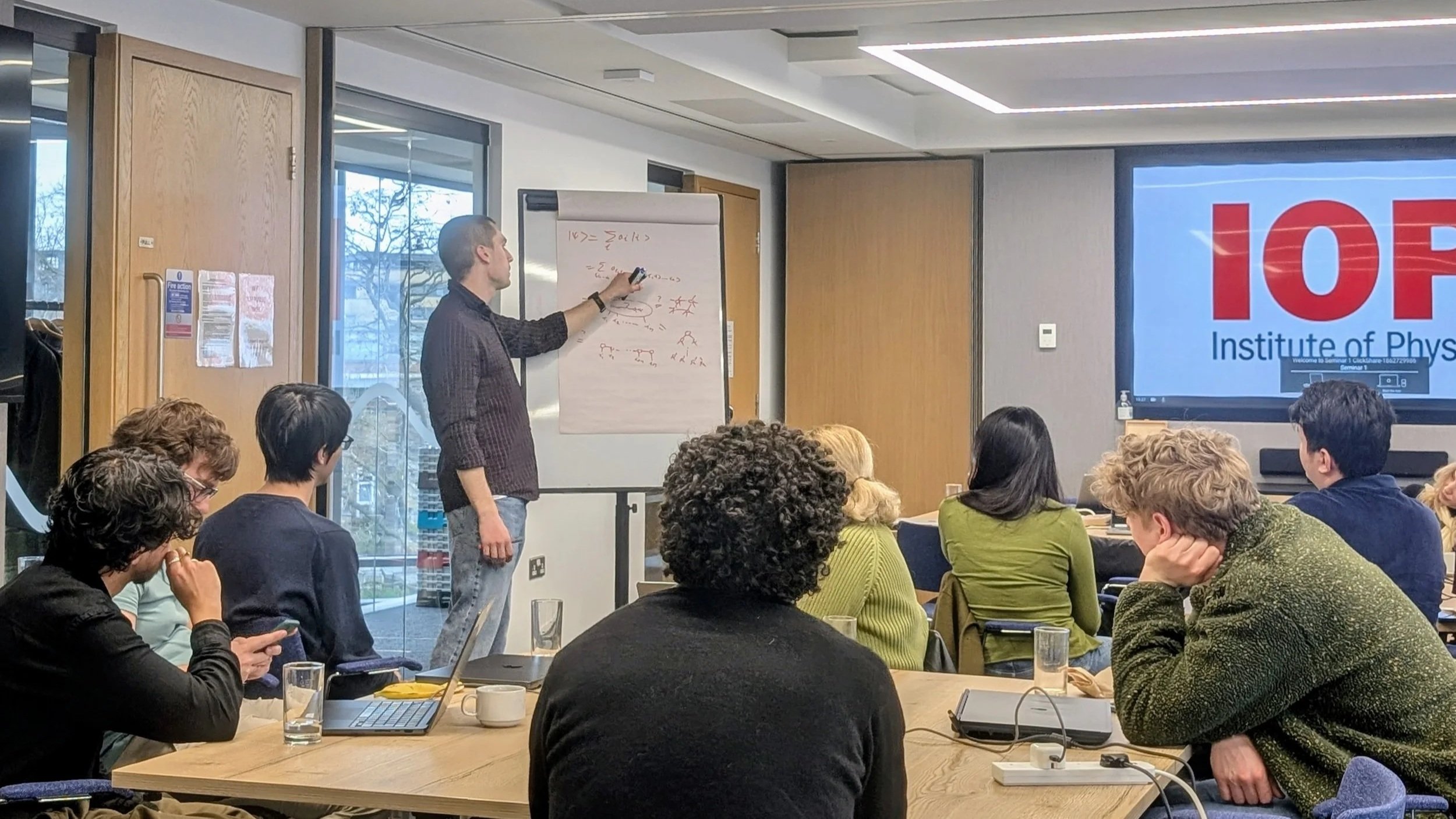
The next lecture-tutorial combo went into image processing and Convolutional Neural Networks, given by Ivan Shalashilin and Kin Ian Lo. We were given some insight into the nature of research taking place at UCL Quantum Learning Labs, alongside working with python toolkits to train and implement a CNN in the tutorial.
Finally, Professor Cristian Bonato gave a lecture on Bayesian Experimental Design, which tied together some of the basics learnt at the start of the workshop, to give us an example of how Bayesian Computational methods can be applied in a quantum physics-based research setting.
Reflecting on what I learned in the workshop, I’m particularly grateful for the breadth of topics covered in the three days, whilst also getting a hands-on experience with implementing some of the techniques in the tutorials. Creating a very basic neural network architecture has helped de-mystify the process for me, and now I am reading further into how they could be implemented in some of our current projects.
Ali Shokat is a first year PhD student in Dr Benjamin Miller’s group at UCL, working on nanodiamond-based in-vitro diagnostics.